Honey Boost ingredients and label
Seven active ingredients, 650 mg per gummy, and every other line the label prints, with what can and cannot be said about each.
The Supplement Facts panel
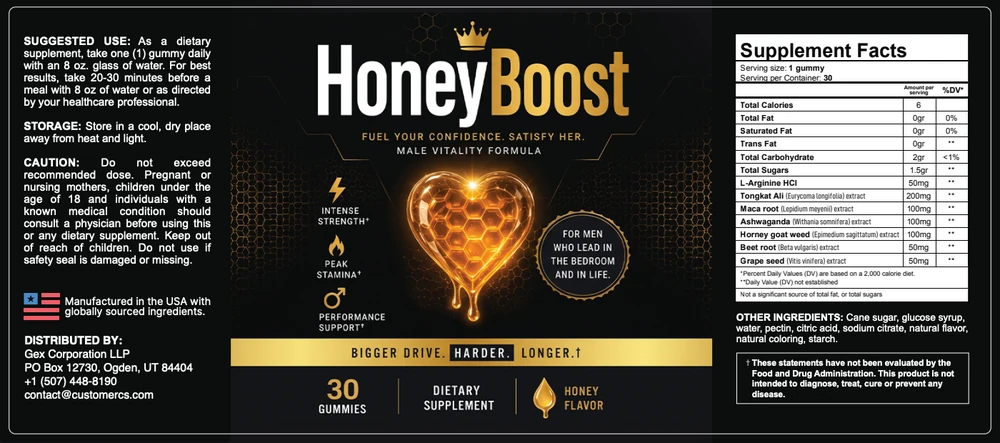
This is the panel from the Honey Boost label, set as a table so it can be read on any screen. The amounts are per gummy, and one gummy is one serving.
| Supplement Facts | Amount per serving | % DV* |
|---|---|---|
| Total Calories | 6 | |
| Total Fat | 0 g | 0% |
| Saturated Fat | 0 g | 0% |
| Trans Fat | 0 g | ** |
| Total Carbohydrate | 2 g | <1% |
| Total Sugars | 1.5 g | ** |
| L-Arginine HCl | 50 mg | ** |
| Tongkat Ali (Eurycoma longifolia) extract | 200 mg | ** |
| Maca root (Lepidium meyenii) extract | 100 mg | ** |
| Ashwaganda (Withania somnifera) extract | 100 mg | ** |
| Horney goat weed (Epimedium sagittatum) extract | 100 mg | ** |
| Beet root (Beta vulgaris) extract | 50 mg | ** |
| Grape seed (Vitis vinifera) extract | 50 mg | ** |
Adding the panel up
The label prints seven separate amounts and no total. Adding them gives 650 mg of active ingredients in each gummy and 19.5 g in a bottle of 30. Tongkat Ali extract is the largest line at 200 mg, about 30.8% of the total.
| Ingredient | Per gummy | Share of the 650 mg | Per bottle (30 gummies) |
|---|---|---|---|
| L-Arginine HCl | 50 mg | 7.7% | 1.5 g |
| Tongkat Ali extract | 200 mg | 30.8% | 6 g |
| Maca root extract | 100 mg | 15.4% | 3 g |
| Ashwagandha extract | 100 mg | 15.4% | 3 g |
| Horny goat weed extract | 100 mg | 15.4% | 3 g |
| Beet root extract | 50 mg | 7.7% | 1.5 g |
| Grape seed extract | 50 mg | 7.7% | 1.5 g |
| All seven | 650 mg | 100% | 19.5 g |
Swipe sideways to see every column.
Because each ingredient has its own line, this is not a proprietary blend: you can see exactly how much of each one a gummy contains.
The seven ingredients, one by one
For each ingredient we separate three things: what the label says, what a general reference says about the ingredient on its own, and what cannot be concluded about the finished gummy. Where we found no authoritative page to cite, we say so and stop.
L-Arginine HCl 50 mg per gummy
- The label
- “L-Arginine HCl, 50 mg”. It is the only one of the seven that is not a plant extract.
- General references
- Arginine is an amino acid; the body makes it and also gets it from protein foods. HCl means it is supplied as the hydrochloride salt. The federal consumer pages we were able to open on November 22, 2026 have no entry for it, so we link none and add nothing from memory.
- Cannot be concluded
- Whether 50 mg a day, a small amount beside what a normal diet supplies, has any effect of its own in this gummy.
Tongkat Ali extract 200 mg per gummy
- The label
- “Tongkat Ali (Eurycoma longifolia) extract, 200 mg”. It is the largest amount in the formula.
- General references
- Eurycoma longifolia is a shrub native to Southeast Asia whose root is used in traditional preparations there. The federal consumer pages we were able to open on November 22, 2026 have no entry for it, so we link none and add nothing from memory.
- Cannot be concluded
- The label does not state which part of the plant is used, the extract ratio or any standardization, so the 200 mg cannot be compared with other products.
Maca root extract 100 mg per gummy
- The label
- “Maca root (Lepidium meyenii) extract, 100 mg”.
- General references
- Maca is a root vegetable of the mustard family, grown at high altitude in the Peruvian Andes and eaten there as food. The federal consumer pages we were able to open on November 22, 2026 have no entry for it, so we link none and add nothing from memory.
- Cannot be concluded
- What 100 mg of an unspecified extract contributes, compared with the gram amounts in which maca is eaten as a food.
Ashwagandha extract 100 mg per gummy
- The label
- “Ashwaganda (Withania somnifera) extract, 100 mg”, spelled that way on the panel.
- General references
- The NCCIH describes ashwagandha as an evergreen shrub used for a very long time in Ayurvedic medicine and promoted today for stress, sleep, male infertility and athletic performance. It reports that some preparations may help with insomnia and stress, that limited evidence suggests taking it for 2 to 4 months may raise testosterone levels and sperm quality, and that evidence for other uses is insufficient. On safety it says short-term use (up to 3 months) may be safe, long-term safety is unknown, stomach upset and drowsiness can occur, and rare cases of liver injury have been reported.
- Cannot be concluded
- The studies behind those statements used a variety of preparations, often at higher amounts. Nothing in them tells you what 100 mg in this gummy will do.
Horny goat weed extract 100 mg per gummy
- The label
- “Horney goat weed (Epimedium sagittatum) extract, 100 mg”, spelled that way on the panel.
- General references
- Epimedium is a group of leafy perennial herbs from East Asia; horny goat weed is the common English name. The federal consumer pages we were able to open on November 22, 2026 have no entry for it, so we link none and add nothing from memory.
- Cannot be concluded
- The extract strength and the compounds it is standardized to, if any, are not stated.
Beet root extract 50 mg per gummy
- The label
- “Beet root (Beta vulgaris) extract, 50 mg”.
- General references
- Beta vulgaris is the ordinary beet. The federal consumer pages we were able to open on November 22, 2026 have no entry for it, so we link none and add nothing from memory.
- Cannot be concluded
- Whether 50 mg of extract is meaningful next to the amount in a serving of beets as a vegetable.
Grape seed extract 50 mg per gummy
- The label
- “Grape seed (Vitis vinifera) extract, 50 mg”.
- General references
- The NCCIH explains that grape seed extract is made from the seeds of wine grapes and contains compounds called proanthocyanidins. It summarizes reviews of small studies on blood lipids and blood pressure with mixed results, and says the extract is generally well tolerated, while advising anyone on medication to speak to a health care provider first.
- Cannot be concluded
- Those reviews covered other products and doses. They say nothing specific about this formula or its male vitality positioning.
Other ingredients
The label lists: cane sugar, glucose syrup, water, pectin, citric acid, sodium citrate, natural flavor, natural coloring, starch. These make the gummy: sweeteners, water, pectin as the gelling agent, citric acid and sodium citrate for tartness and setting, flavor, color and starch. Honey is not among them; the gummy is honey-flavored.
Per gummy the panel shows 6 calories, 2 g of total carbohydrate and 1.5 g of total sugars. Over a bottle that is 180 calories and 45 g of sugars, by our multiplication.
Allergens and dietary notes
The label carries no allergen statement. No gelatin is listed; the gelling agent is pectin. The brand’s home page shows vegetarian, dairy-free and gluten-free badges, but the label itself does not print those words. If you have an allergy or follow a strict diet, ask the seller at [email protected] before ordering.
Directions, caution and storage
- Suggested use: as a dietary supplement, take one (1) gummy daily with an 8 oz glass of water. For best results, take 20 to 30 minutes before a meal with 8 oz of water, or as directed by your healthcare professional.
- Caution: do not exceed the recommended dose. Pregnant or nursing mothers, children under the age of 18 and individuals with a known medical condition should consult a physician before using this or any dietary supplement.
- Safety: keep out of reach of children. Do not use if the safety seal is damaged or missing.
- Storage: store in a cool, dry place away from heat and light.
A five-point label check when the bottle arrives
Seal
The safety seal under the cap should be intact.
Name and count
The front should read HoneyBoost, 30 gummies, dietary supplement, honey flavor.
Panel
Seven ingredient lines that add up to 650 mg, with a serving size of one gummy.
Distributor
Gex Corporation LLP, with the support email and phone number.
Differences
If anything on your bottle differs from this page, the bottle is right. Tell us and we will correct the page.
General background on supplements, how they are regulated and how to use them sensibly: NCCIH, Using Dietary Supplements Wisely, MedlinePlus, Dietary Supplements and FDA, Questions and Answers on Dietary Supplements.
Sources
- Product source: the Honey Boost brand page and its label artwork, the order page, the seller’s returns, terms and contact pages, and the BuyGoods checkout, read on November 22, 2026.
- General reference: National Center for Complementary and Integrative Health. Ashwagandha: Usefulness and Safety.
- General reference: National Center for Complementary and Integrative Health. Grape Seed Extract: Usefulness and Safety.
- General reference: National Center for Complementary and Integrative Health. Using Dietary Supplements Wisely.
- General reference: MedlinePlus, National Library of Medicine. Dietary Supplements.
- General reference: U.S. Food and Drug Administration. Questions and Answers on Dietary Supplements.
- Our own arithmetic: totals, cost per day, milligram sums and pack comparisons are calculated from the label and the prices above.